
Portfolio Careers, Neurodivergence, and the Rise of the Multi-Hyphenate Life
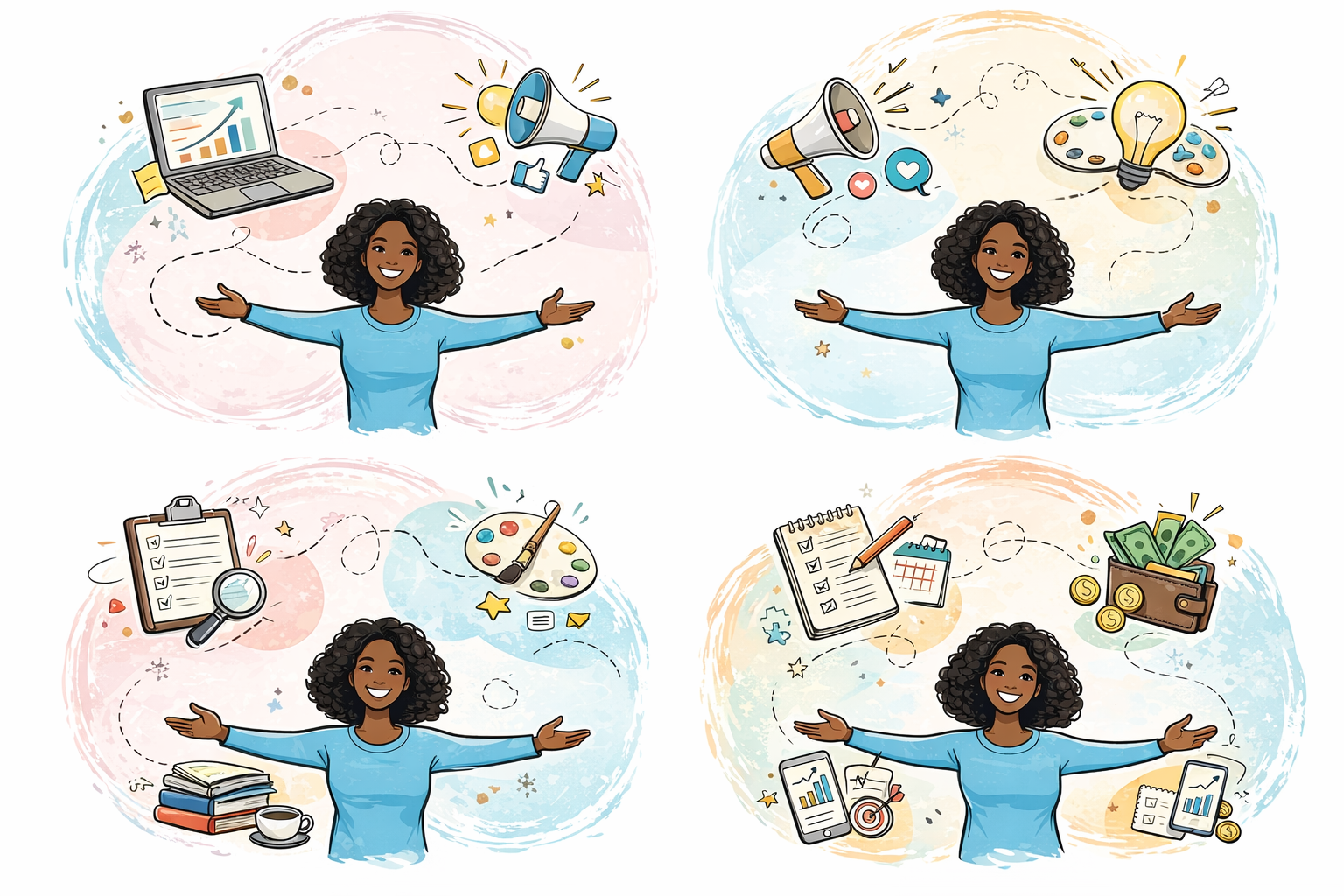
A set of four illustrated scenes featuring a Black woman with open arms, surrounded by interconnected icons representing a portfolio career. Each illustration highlights different income streams and creative paths including digital work, entrepreneurship, content creation, learning, financial planning, and personal growth. The visuals use soft pastel backgrounds, hand-drawn linework, and playful iconography to represent multidimensional careers, nonlinear success, and modern professional identity.
For decades, we were told a single story about success. Pick one path. Choose one title. Stay consistent. Specialize early. Stick it out.
But for many neurodivergent people, that story never fit. Not because we lacked focus or commitment, but because our minds were built for synthesis, curiosity, and movement.
Today, a growing number of people are rejecting linear career ladders in favor of portfolio careers. And neurodivergent thinkers are quietly leading the shift.
A portfolio career is not a failure to commit. It is a strategic, creative, and often deeply embodied response to a changing economy and a changing understanding of how human minds actually work.
What Is a Portfolio Career?
A portfolio career refers to a professional life composed of multiple roles, income streams, and projects rather than a single full-time job. This might include part-time employment, consulting, freelancing, entrepreneurship, creative work, teaching, or community leadership. Instead of anchoring identity and income to one role, individuals distribute their labor and creativity across several domains.
Originally discussed in the context of creative and freelance industries, portfolio careers are now expanding across healthcare, education, technology, and entrepreneurship. As job security erodes and burnout rises, many people are choosing flexibility and diversification over rigidity.
This model offers both economic resilience and psychological autonomy. If one income stream slows, others remain. If one role becomes draining, energy can be redirected elsewhere. In an unstable world, adaptability becomes a form of stability.
Why Do Portfolio Careers Appeal to Neurodivergent Minds?
Neurodivergent people, including those with ADHD, autism, and other cognitive differences, often experience heightened curiosity, nonlinear thinking, and variable energy patterns. Traditional work environments frequently punish these traits rather than support them.
Research consistently shows that neurodivergent individuals thrive in environments that allow autonomy, flexible scheduling, and task variation. Portfolio careers naturally provide these conditions.
Many neurodivergent people also experience what psychologists call multipotentiality. This refers to the capacity to excel in multiple areas rather than specializing narrowly. While society often frames this as indecision or lack of focus, it can actually reflect advanced pattern recognition and integrative thinking.
Portfolio careers allow neurodivergent individuals to move between projects based on interest, capacity, and season of life. This reduces burnout and increases engagement. Instead of forcing sustained attention on a single role, energy is distributed across multiple meaningful pursuits.
How Can Being a “Jack of All Trades” be Beneficial?
The phrase “jack of all trades, master of none” has long been used to dismiss people who refuse to specialize. What is often forgotten is the full version of the saying: “Jack of all trades, master of none, but oftentimes better than master of one.”
In complex systems, adaptability matters. The ability to learn quickly, integrate information across domains, and respond creatively to new challenges is increasingly valuable. Employers and clients alike are beginning to recognize that hybrid skill sets are not liabilities. They are assets.
Neurodivergent thinkers often excel at connecting ideas across disciplines. A therapist who understands branding. A clinician who builds community programs. A creative who understands systems and structure. Portfolio careers legitimize this kind of integrated intelligence.
“The portfolio career is a way of working that enables people to balance paid and unpaid work, creativity and security, work and life.”
Entrepreneurship as a Nervous System Strategy
For many neurodivergent people, entrepreneurship is not just a career move. It is a nervous system accommodation.
Traditional workplaces often demand rigid schedules, constant social performance, and sensory environments that overwhelm neurodivergent nervous systems. Entrepreneurship offers the possibility of designing work around actual human needs rather than outdated productivity models.
This does not mean entrepreneurship is easy. It often involves financial uncertainty, executive functioning challenges, and administrative overload. But it also offers something many neurodivergent people have never experienced at work: agency.
When individuals can control pacing, environment, and scope, they are more likely to sustain meaningful work long term. Entrepreneurship and portfolio careers allow people to build livelihoods that fit their bodies and brains instead of constantly overriding them.
Portfolio Careers & the Mental Health Dimension
Burnout is not just an individual failure. It is a systemic outcome of work structures that ignore human limits. Studies increasingly show that lack of autonomy, role rigidity, and misalignment between values and labor contribute significantly to anxiety, depression, and chronic stress.
Portfolio careers can reduce these pressures by allowing people to align work with values, vary cognitive demands, and maintain a sense of agency. This is especially important for neurodivergent individuals who may already be navigating a world not designed for them.
From a therapeutic lens, meaning, autonomy, and flexibility are protective factors. Work that supports these elements can become a source of regulation rather than dysregulation.
What are Some Challenges of the Portfolio Career Model?
It would be dishonest to romanticize portfolio careers without acknowledging their challenges.
Income can fluctuate. Benefits often need to be self-funded. Identity can feel fragmented in a culture obsessed with job titles. Self-management becomes essential, and not everyone has access to the safety nets that make experimentation possible.
For neurodivergent individuals, executive functioning demands can be significant. Systems, support, and community matter. Without them, a portfolio career can quickly become overwhelming.
This is where intentional design becomes critical. Successful portfolio careers are not chaotic. They are structured ecosystems. They rely on routines, boundaries, financial planning, and support networks.
How Can a Sustainable Portfolio Career Be Built?
For those drawn to this path, sustainability matters more than hustle. A few guiding principles help make portfolio careers viable long term.
First, identify a unifying thread. Even diverse roles benefit from a shared mission or value system. This provides coherence and reduces decision fatigue.
Second, build systems early. Time management, financial tracking, and clear boundaries protect energy and prevent burnout.
Third, allow seasons. Portfolio careers are not static. Some roles expand while others recede. Flexibility is a feature, not a flaw.
Finally, release the need for external validation. Portfolio careers often confuse people who rely on linear narratives. Your career does not need to make sense to everyone. It needs to make sense to you.
Portfolio Careers Represent a Broader Cultural Shift
The rise of portfolio careers reflects broader cultural changes. Younger generations prioritize flexibility, purpose, and mental health over traditional markers of success. The gig economy, remote work, and digital platforms have made alternative career structures more accessible.
At the same time, there is growing recognition that neurodiversity is not a deficit but a form of human variation. As this understanding spreads, work structures are beginning to shift.
Portfolio careers sit at the intersection of these changes. They represent a future where work adapts to humans rather than humans contorting themselves to fit work.
Root to Bloom
At NeuroBloom, we believe healing and livelihood are deeply connected. When people are allowed to build careers that honor their nervous systems, creativity, and values, they do more than survive. They bloom.