
Why Volunteering Is Good for Us
“Agency returns when action meets community.”
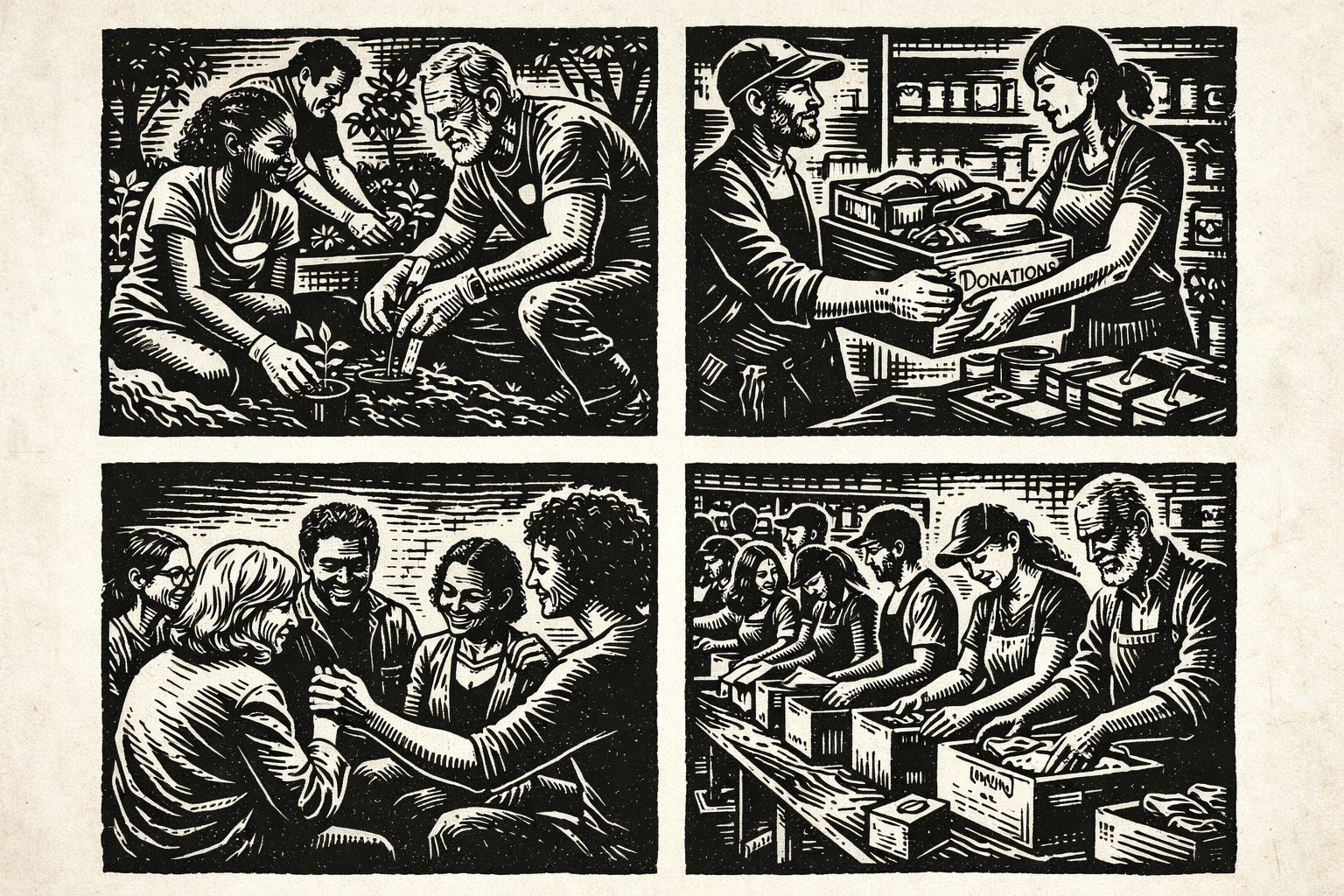
There is a common assumption that healing is primarily an individual task. If we regulate ourselves well enough, think clearly enough, or find the right therapist, we will eventually feel better. Personal work matters, and therapy can be transformative, but the human nervous system did not develop in isolation. It developed in groups, in shared labor, and in collective care.
From a neuroscience and mental health perspective, volunteering, mutual aid, and community organizing are not secondary to healing. They are regulatory experiences that influence stress physiology, restore agency, and strengthen meaning-making systems in the brain. In a period marked by chronic stress and collective strain, that has real consequences for how we function.
Learned helplessness and the loss of agency
Psychology offers a framework for understanding what happens when repeated stress teaches the brain that effort does not influence outcomes. It is called learned helplessness . When stress is prolonged and feels uncontrollable, the nervous system adapts accordingly. Cortisol remains elevated, vigilance increases, dopamine signaling tied to motivation decreases, and the prefrontal cortex becomes less effective under sustained pressure.
Over time, initiation drops. Action begins to feel disconnected from impact. This pattern is often visible in anxiety, depression, racial trauma, economic instability, and burnout. The brain conserves energy when it predicts that effort will not matter.
That prediction can shift, but it shifts through experience rather than intention. The nervous system updates when it encounters consistent evidence that action produces change.
The nervous system is relational
“When stress is collective, healing must be relational.”
Human stress physiology is shaped by co-regulation, the process through which our bodies stabilize in connection with others. Social neuroscience research demonstrates that strong social ties support long-term health and influence brain function. Social support reduces cortisol reactivity and buffers physiological stress responses, while social isolation is associated with increased inflammation and higher mortality risk.
Our brains are wired for shared survival, not solitary recovery.
When people volunteer or participate in collective efforts, they enter environments organized around shared purpose. There is coordination, mutual recognition, and visible contribution. These conditions send regulatory signals to the nervous system. Community involvement becomes more than civic engagement; it becomes a repeated physiological reminder that one is embedded in a network rather than operating alone.
Helping activates reward and caregiving systems
Prosocial behavior engages neural circuits associated with reward and reinforcement. Functional imaging studies show activation in fronto-mesolimbic pathways when individuals donate or provide support [5]. These pathways are linked to dopamine signaling and motivational drive. Providing support to others is also associated with activation in caregiving-related neural regions and reduced threat reactivity.
These mechanisms help explain why many people describe community work as grounding, even when the content of that work is emotionally heavy. The brain encodes contribution as relevant and purposeful.
Research examining volunteering as a public health intervention finds associations between regular engagement and lower depressive symptoms, along with improved well-being . Meaning is not an abstract concept in this context. It has measurable psychological and physiological correlates.
Mutual aid and collective efficacy
“Community care is not charity. It is regulation.”
Chronic stress narrows perceived control. Trauma can reinforce the belief that nothing one does will alter the broader environment. Participation in mutual aid disrupts that loop by making impact visible. Resources move. Needs are addressed. Relationships form around shared responsibility.
This creates a feedback process in which effort leads to outcome.
Research on collective efficacy shows that shared belief in a group’s capacity to influence events strengthens persistence and psychological resilience. Agency increases when individuals experience themselves as part of coordinated action. The nervous system adapts to evidence that action has consequence.
Community care and burnout
Burnout is strongly associated with chronic stress combined with low autonomy and insufficient support [9]. It often emerges in environments where responsibility is high and control is limited.
Community-based efforts distribute responsibility across a network. Emotional labor is shared. Roles rotate. Rest becomes visible and permissible. These structural shifts alter the stress load carried by any one person.
Rest, regulation, and collective healing
REST 2026, presented by NeuroBloom Mental Health Collective and For Real Therapy, reflects this understanding of regulation and participation. Trauma research consistently demonstrates that safety and physiological stabilization are prerequisites for healing. Rest supports integration within the nervous system and allows stress responses to recalibrate.
REST 2026 expands rest beyond sleep to include embodiment, cultural memory, creativity, and joy. The series brings together licensed mental health practitioners, artists, and cultural workers to create structured space for grounding while raising funds for Sudanese-led mutual aid. Public health research on community resilience shows that social cohesion improves recovery outcomes following collective stress and disaster.
Regulation and participation reinforce one another while shared rest strengthens shared resilience.
Why this matters now
Current stressors are layered and ongoing: climate instability, armed conflict, economic precarity, racial violence, professional burnout. The individual nervous system was not designed to metabolize sustained collective strain in isolation.
Community involvement does not eliminate systemic harm. It shifts how stress is processed and distributed. When people organize together, volunteer together, and rest together, they generate conditions that support agency, regulation, and meaning. These are measurable biological processes, not abstract ideals.
If you are feeling stuck
Start within your capacity. Attend a local event in Chicago. Participate in mutual aid. Volunteer in a way that is sustainable. Engage with REST 2026 if it aligns.
The nervous system responds to lived evidence and agency strengthens with repetition. Healing remains relational.