NeuroBloom offers individual therapy, group programming, and workshops or collaborations. If you need ongoing one-to-one support, start with Individual Therapy. Groups and workshops have their own participation and inquiry paths.
Individual therapy gives you time to focus on your own goals with a clinician. A group brings people together around a shared topic or set of skills. You can ask about either option during a free consultation, including whether a relevant group is currently open.
Yes. Tell us the type of evaluation you’re looking for so we can confirm current availability, scope, and next steps. Use general inquiries for the initial question and ask how to share sensitive documents securely.
Start with a free consultation if you are considering therapy. You can describe what has been difficult lately, even if you don’t have a diagnosis or a preferred therapy approach. Book a free consultation.
Yes. Our therapists work with people navigating migration, bicultural identity, and family expectations across generations. You can decide how much of your cultural or family experience you want to bring into therapy.
Your clinician can make room for how language, family, race, faith, and migration shape your experience. If a past therapist misunderstood an important part of your life, you can ask a NeuroBloom clinician about that during a consultation.
Yes. If sensory needs, communication preferences, masking, gender, or sexuality matter to your care, you can bring them up early. Read about neurodivergent-affirming therapy or ask a clinician about their approach.
Age groups and areas of focus vary by clinician. Check the team profiles and use a consultation to verify fit and appointment availability.
Start with the group information on this page and ask about current openings before making plans. Group dates, eligibility, and enrollment can change, so contact NeuroBloom if you aren’t sure which program is accepting inquiries.
The format depends on the group. Some groups focus on sharing and processing experiences, while others include more structured skills practice. Ask about the format and expectations if you’d like to know how much discussion or activity is involved.
Follow the interest or registration instructions for the group you’re considering. The group description or a follow-up from the practice can explain whether there is a screening, when sessions meet, and what to expect before joining.
Ask about the specific group before enrolling. Individual therapy fees and an insurance plan’s individual-session benefits can differ from group costs or coverage.
Start with the concern you want help with and the circumstances that will shape your care. Compare specialties, languages, age groups, approaches, and insurance information on the profiles. Then ask about schedule and fit during a consultation.
Yes. If language, culture, faith, or experience with a particular community matters to you, use those details to guide your search. Mention any preferences when you reach out so you can discuss them with the clinician.
Choose the person whose approach you’re most curious about, or use the general consultation if you want help narrowing the options. You can ask how a therapist would approach the concern that brought you in.
Start with the clinician’s profile or booking page, then check your specific plan with the practice and your insurer. Payment & Policies explains the practice-wide insurance information.
You can share what you’re looking for and ask about the therapist’s approach, availability, insurance, or fees. You can also ask how to start therapy if it feels like a good fit.
If you know whom you want to meet, use that clinician’s booking page. If you’re still comparing options, the general consultation is a place to talk through what matters to you. You can also meet the therapists before selecting a time.
Share the exact plan name when you ask about participation, especially if you have an HMO or want to use telehealth benefits. Review the payment policies and confirm clinician-specific coverage before your first paid visit.
Ask the therapist about ongoing appointment availability and the next intake steps. If you need a particular time or frequency, bring that up so you can decide whether the schedule is workable.
NeuroBloom offers culturally responsive therapy for concerns such as trauma, adult ADHD, anxiety, grief, and life transitions. Our clinicians work with people across a range of identities and backgrounds. Explore who we serve.
Yes. NeuroBloom is based in Chicago and offers online therapy in Illinois. Ask which clinician can work with you if you’ll be attending from another state or regularly travel.
Eligible plans vary by insurer and clinician. Start with Payment & Policies, then verify your specific plan before the first paid visit.
You can book a free consultation to ask about therapist fit, availability, insurance, and what starting therapy would involve. If you want to meet a particular therapist, start with their profile.
It’s common for concerns to overlap. For example, a person might want help with ADHD and also be dealing with anxiety, burnout, or trauma. A clinician can help you decide where to begin based on what is affecting you day to day.
You can reach out with a concern or a pattern you’ve noticed. If you want a formal evaluation or documentation, mention that up front so the practice can clarify what is available.
Use the specialty pages to understand the kind of support you’re looking for, then compare the clinician profiles. A general consultation can help if several options look relevant.
Your therapist can discuss your goals, what you’ve tried, and how much structure feels helpful. Some clinicians draw from several approaches. Ask what that would look like for the concern you want to work on.
Yes. You might prefer an agenda and concrete skills, or more room to talk through what came up that week. Tell your therapist what helps you participate and revisit it as you go.
Yes. If something is helpful, confusing, or hard to use outside a session, bring it up. Your clinician can explain why they suggested an approach and discuss other options that fit your goals.
Organizations such as schools, nonprofits, employers, and community groups can ask about a workshop. Tell us who would attend and what you want participants to learn or take away.
Use the inquiry form to share the audience, topic, access needs, and preferred timing. We can discuss what format and scope would fit before you commit.
Use the collaboration inquiry page. Include your organization, proposed dates, and a brief description of what you have in mind.
Workshops are set up for learning, discussion, or community participation. Group therapy is clinical care, with its own enrollment process and expectations. Explore Group Therapy if you’re looking for a clinical group.
Use this page for workshops, speaking, partnerships, media, and general inquiries. Share what you’re looking for and any relevant timeline. Keep sensitive clinical or legal documents out of the initial message.
Use the free consultation page to find a booking option. If you want to work with a specific clinician, you can go through that person’s profile.
Include who you represent, the audience, your tentative dates, and what you hope to accomplish. If you have access needs or format preferences, include those too so the discussion can start with what your group needs.
NeuroBloom grew from seeing how often conventional care left out important parts of people’s lives. The practice was built to make room for culture, identity, disability, and community alongside the concerns that bring someone to therapy.
It shapes the questions clinicians ask about what’s happening around you and what support is actually accessible. You can decide which parts of your life you want your clinician to understand as you work together. Read more about our approach and values.
It means making room for how things such as discrimination, work conditions, or barriers to care affect your mental health. Sessions can include talking through choices, support, grief, and what change is possible in your situation.
You can ask for changes that help you participate, such as a slower pace, clearer structure, or different ways to talk through a difficult subject. You can also tell your clinician when their understanding of your experience feels off.
The practice offers therapy and also participates in educational and community programs. You can explore current and past events to see how that work shows up outside sessions.
NeuroBloom brings clinicians with different areas of focus and lived perspectives into one practice. For people seeking care, the team offers several ways to explore fit, such as specialty, language, and approach.
Individual therapy is one-to-one with your clinician. Group therapy has a separate format and enrollment process. To compare the options, start with NeuroBloom’s services.
You can ask how Azzah works with your concerns, including complex trauma or adult ADHD, and what starting care would involve. If you prefer sessions in Sudanese Arabic, use the consultation to talk through your language preferences. Read Azzah’s profile.
Azzah sees clients with eligible UnitedHealthcare and Optum plans in Illinois. Confirm your exact plan and telehealth benefits before scheduling paid sessions.
Bring the days and times that are workable for you to the consultation. Ask what ongoing appointments are available before you decide whether to start.
Yes, those are areas of focus in Jasmine’s work. A consultation gives you time to ask what sessions might involve when you’re coping with a loss, a caregiving role, or a major change. Read Jasmine’s profile.
Jasmine sees clients with eligible UnitedHealthcare and Optum plans in Illinois. Confirm that your specific plan covers visits with Jasmine before you schedule a paid session.
Bring up any scheduling limits during the consultation, including times when you can reliably have privacy. Ask about ongoing appointment availability so you can decide whether it fits your routine.
You can ask how Sana adapts sessions for sensory preferences, communication, or overwhelm. You can also ask how she works with your age group and what the first sessions might look like. Read Sana’s profile.
Yes. Share the language you would prefer and ask how Sana can use it during sessions. The consultation is also a place to confirm whether the schedule and approach fit.
Confirm that Sana participates in your exact insurance plan and ask whether it covers online sessions. Use Payment & Policies as a starting point for questions about coverage or fees.
Yes. You can ask how Anahi works with concerns such as getting started on tasks, managing overwhelm, or making routines more workable. Read Anahi’s profile for more about her approach.
Yes. Tell Anahi whether you prefer Spanish, English, or a mix of both. It’s fine to bring this up at the start so you can see how the conversation feels.
Have the exact plan name available when you ask. Confirm Anahi’s participation and telehealth coverage before the first paid visit. See Payment & Policies for practice-wide information.
You can ask about Shontae’s movement and expressive approaches regardless of your experience with either. Talk through what feels accessible and comfortable for you. Read Shontae’s profile.
Yes. Ask about what can be done in the space you have and whether a session can rely more on conversation or other approaches. You can share any mobility, sensory, or privacy preferences you want her to keep in mind.
Ask the practice and your insurer about Shontae’s participation in your exact plan and your telehealth benefits. If you’re considering self-pay, review Payment & Policies and ask about current options.
The audience varies by event. Some gatherings are for the wider community, while others are designed for therapists or a specific group of participants. Check the event description before registering.
Check the listing for the specific event for dates, location, cost, and registration instructions. If you need information about access, seating, or the format, use the contact details on that listing or contact NeuroBloom.
Yes, you can inquire through the collaboration page. Tell us about your organization, the people you hope to reach, and what you’d like to create together.
Workshops, cultural gatherings, and community programs in Chicago.
Future dates will be posted here when confirmed.
A Chicago community for BIPOC mental health professionals to connect, share resources, and build referral relationships.
Bring a task, a creative project, or a quiet activity and spend time doing it alongside other people.
Read A Night in Sudan: Sudan as a Living Archive or explore the Past Events archive for original flyers and recaps. Learn more about our commitment to mutual aid and the work each fundraiser supported.
Browse the original invitations and select a flyer to read its recap. View all past events.
 A Night in SudanNovember 14, 2026
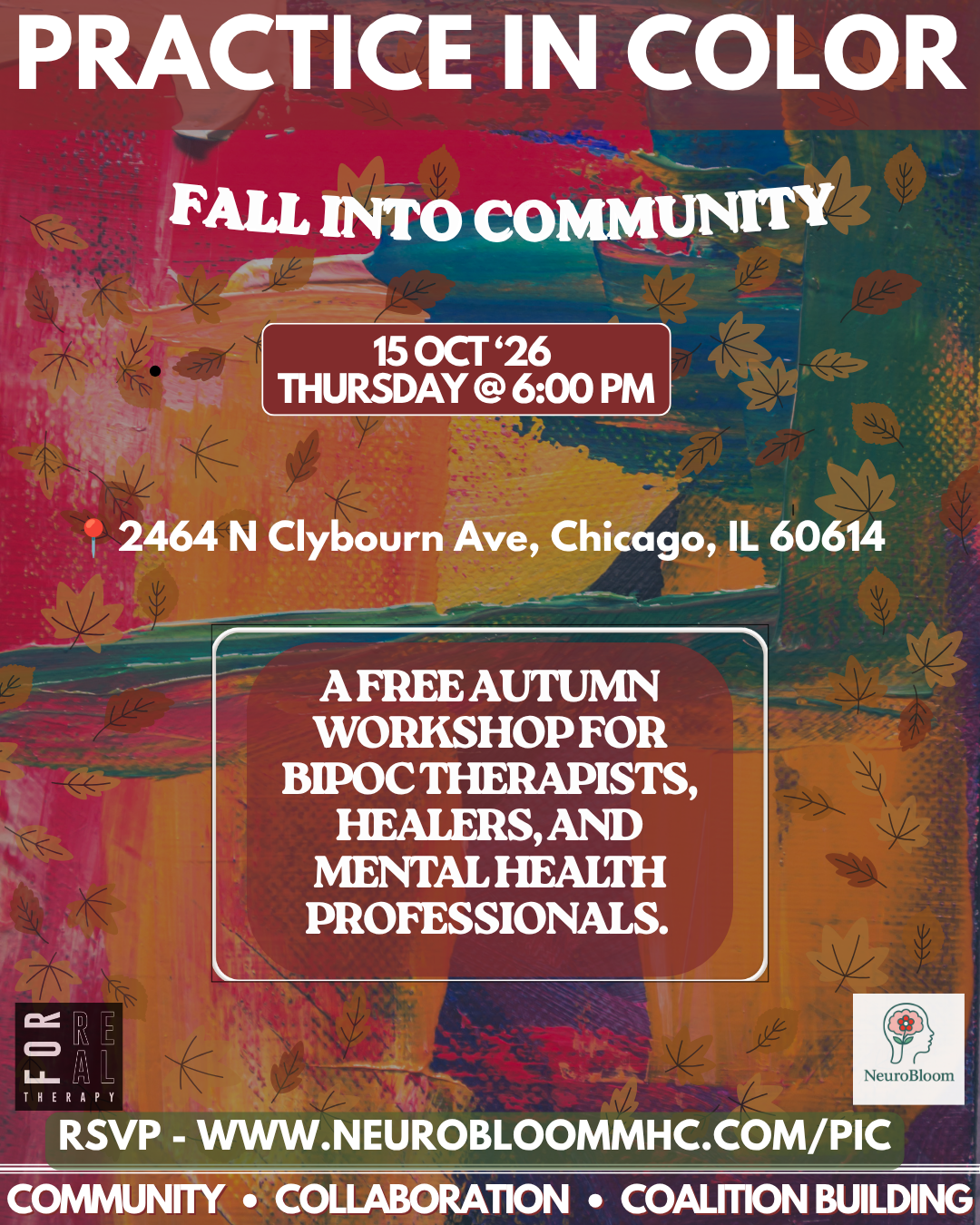 Practice in Color: Harvesting CommunityOctober 15, 2026
 Parallel OrbitOctober 11, 2026
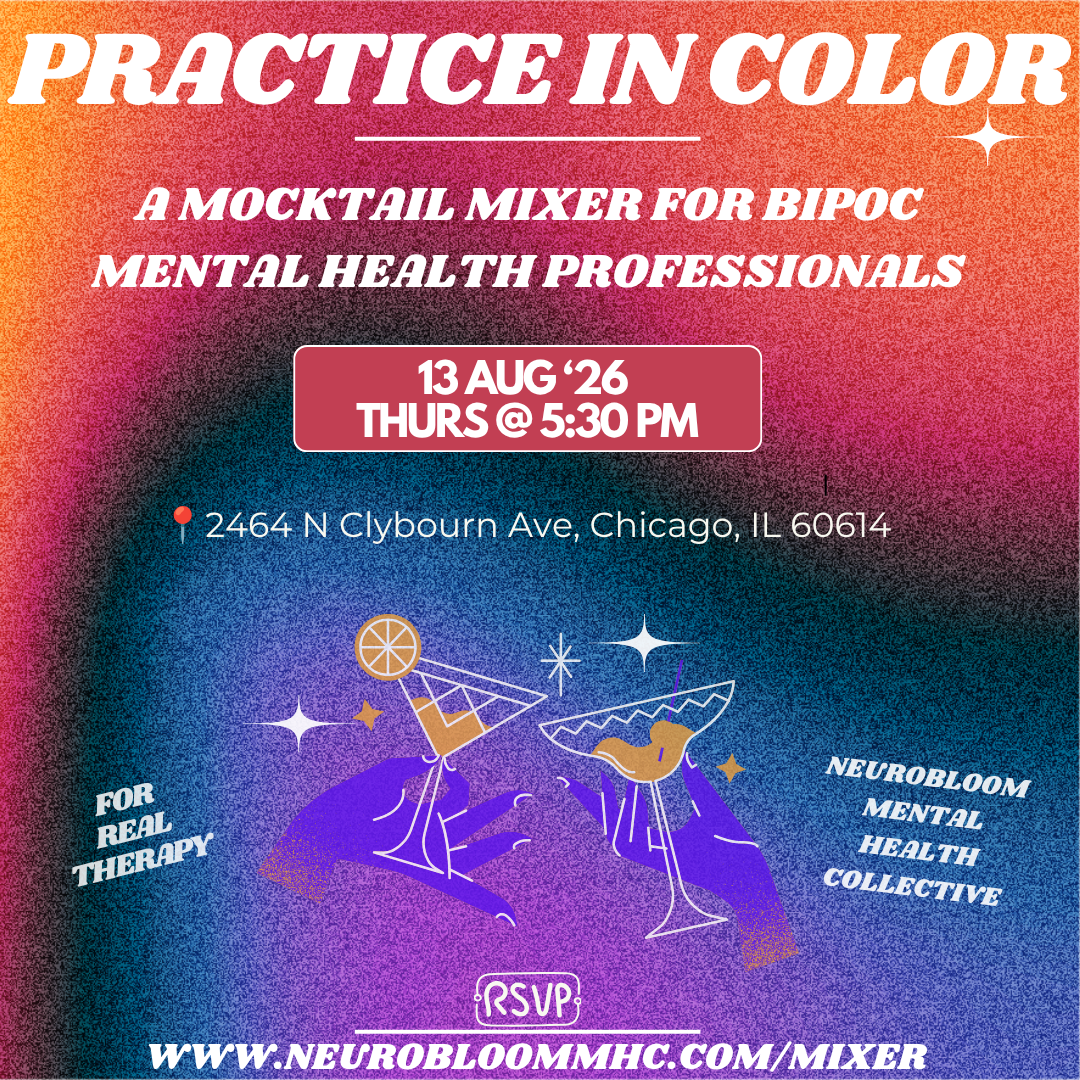 Practice in Color Mocktail MixerAugust 13, 2026
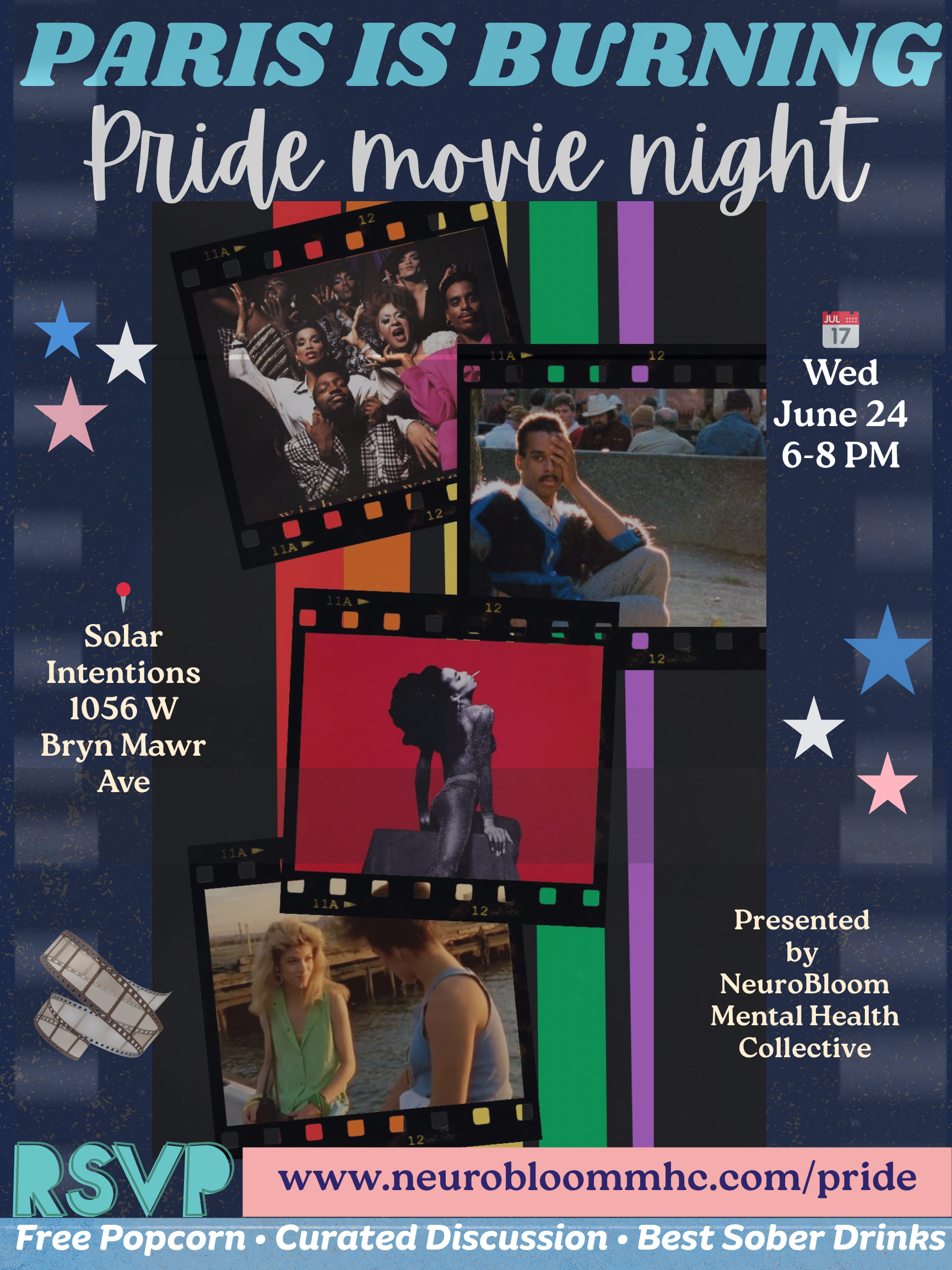 Paris Is Burning: Pride Movie NightJune 24, 2026
 Dare to Dream: A Juneteenth Collective Futures LabJune 17, 2026
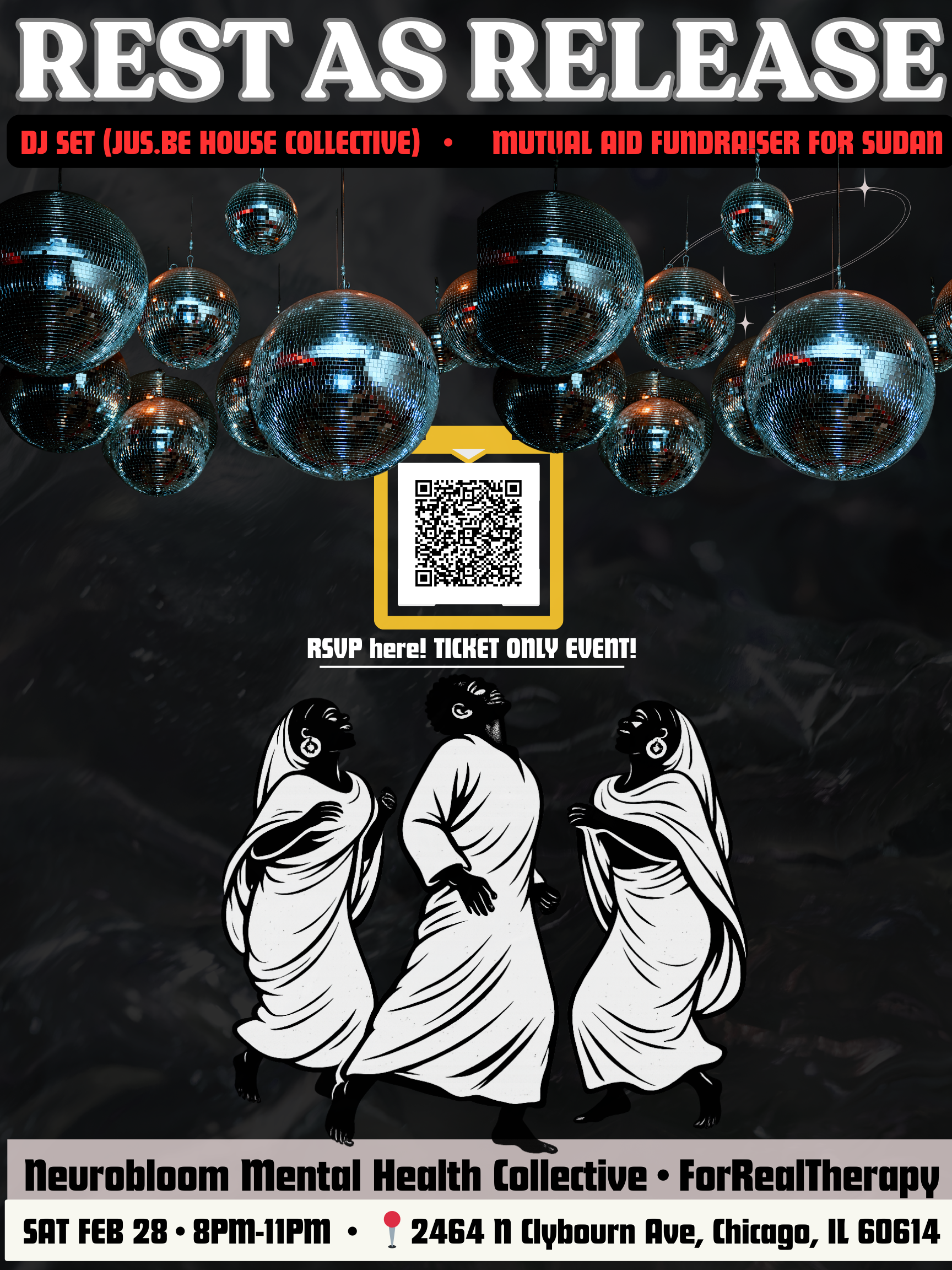 REST as Release: DJ Set and Collective Dance PartyFebruary 28, 2026
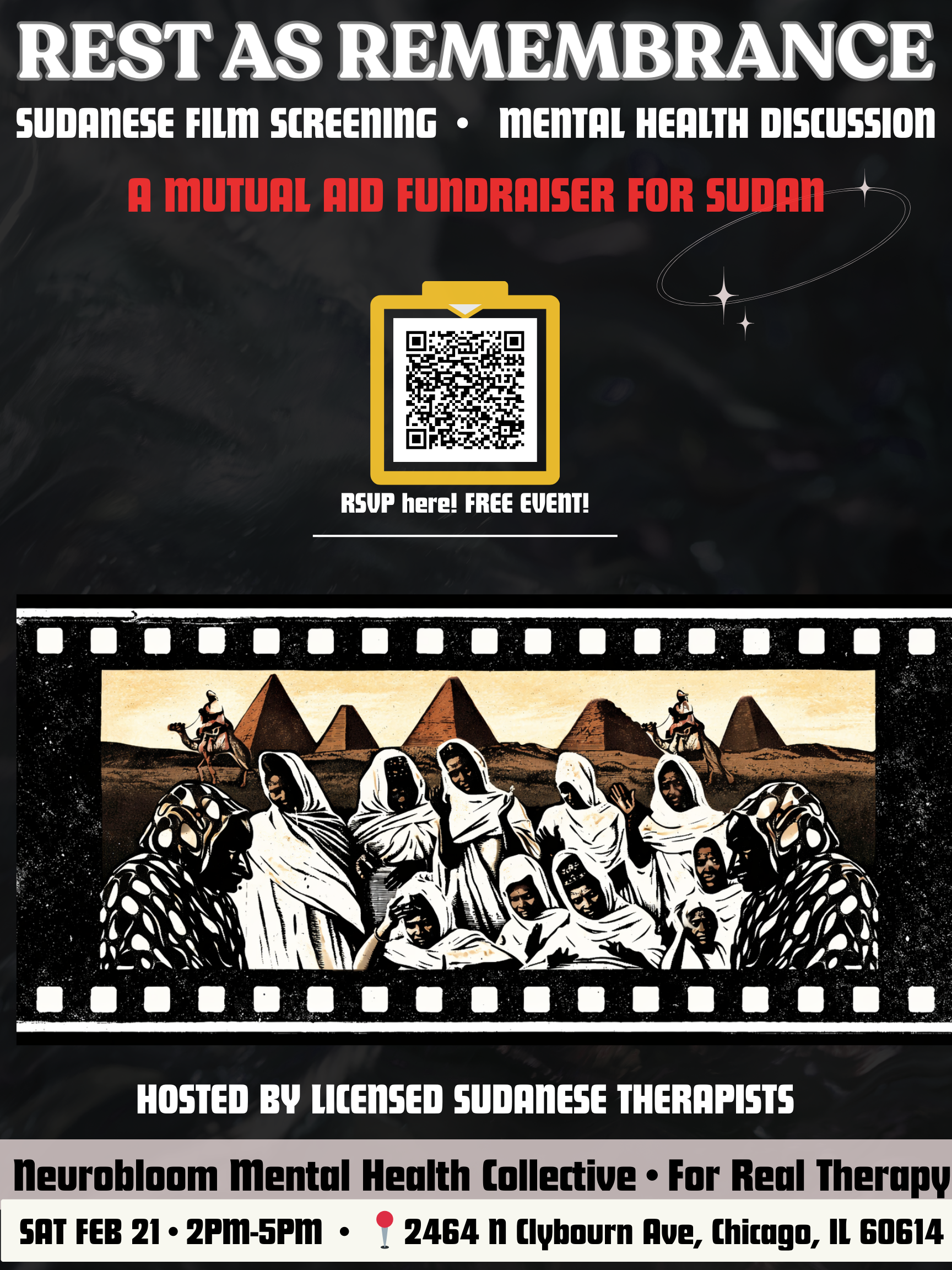 REST as Remembrance: Sudanese Film Screening and Q&AFebruary 21, 2026
 REST as Reclamation: Sudanese Poetry WorkshopFebruary 14, 2026
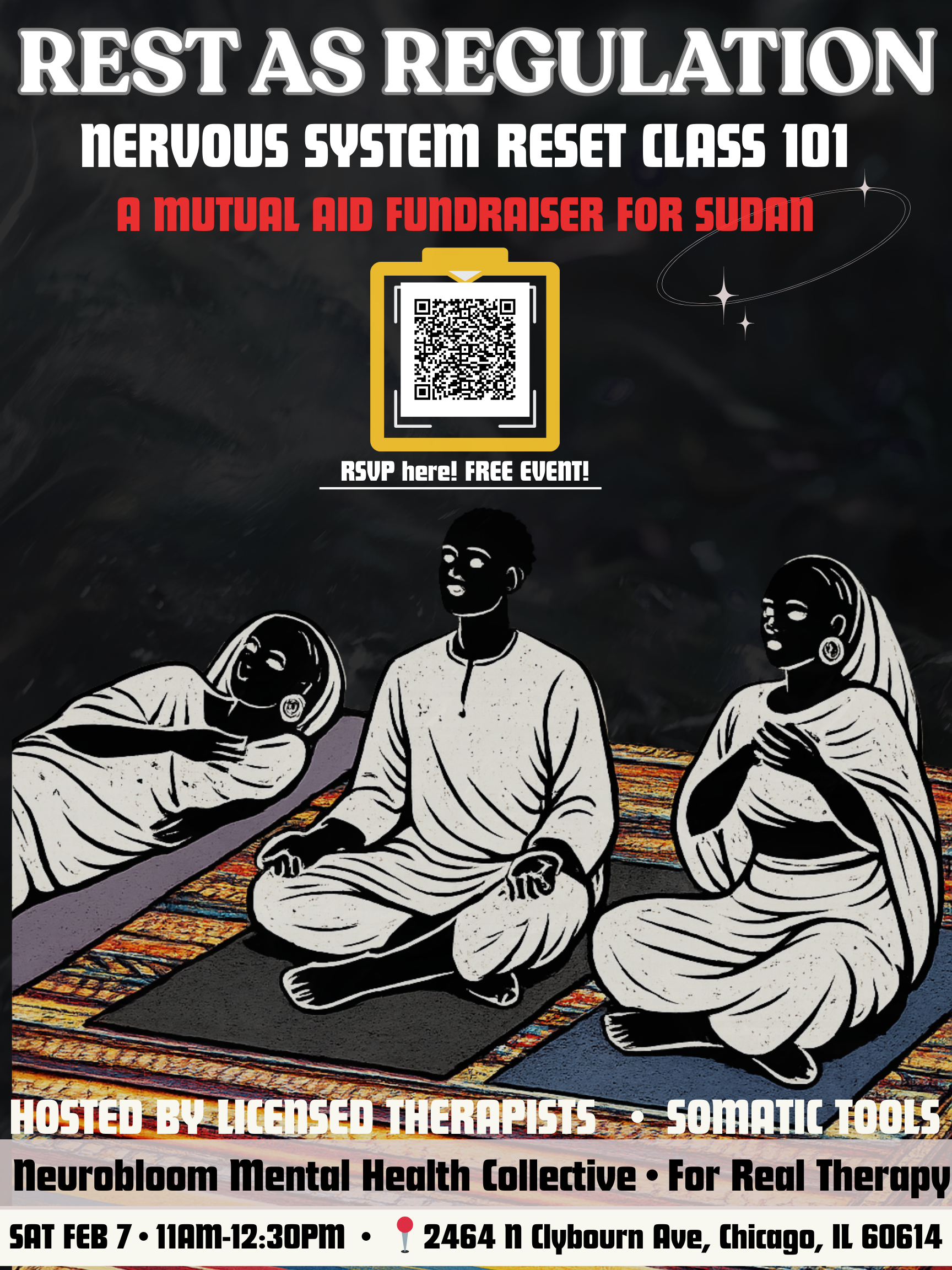 REST as Regulation: Nervous System Reset ClassFebruary 7, 2026
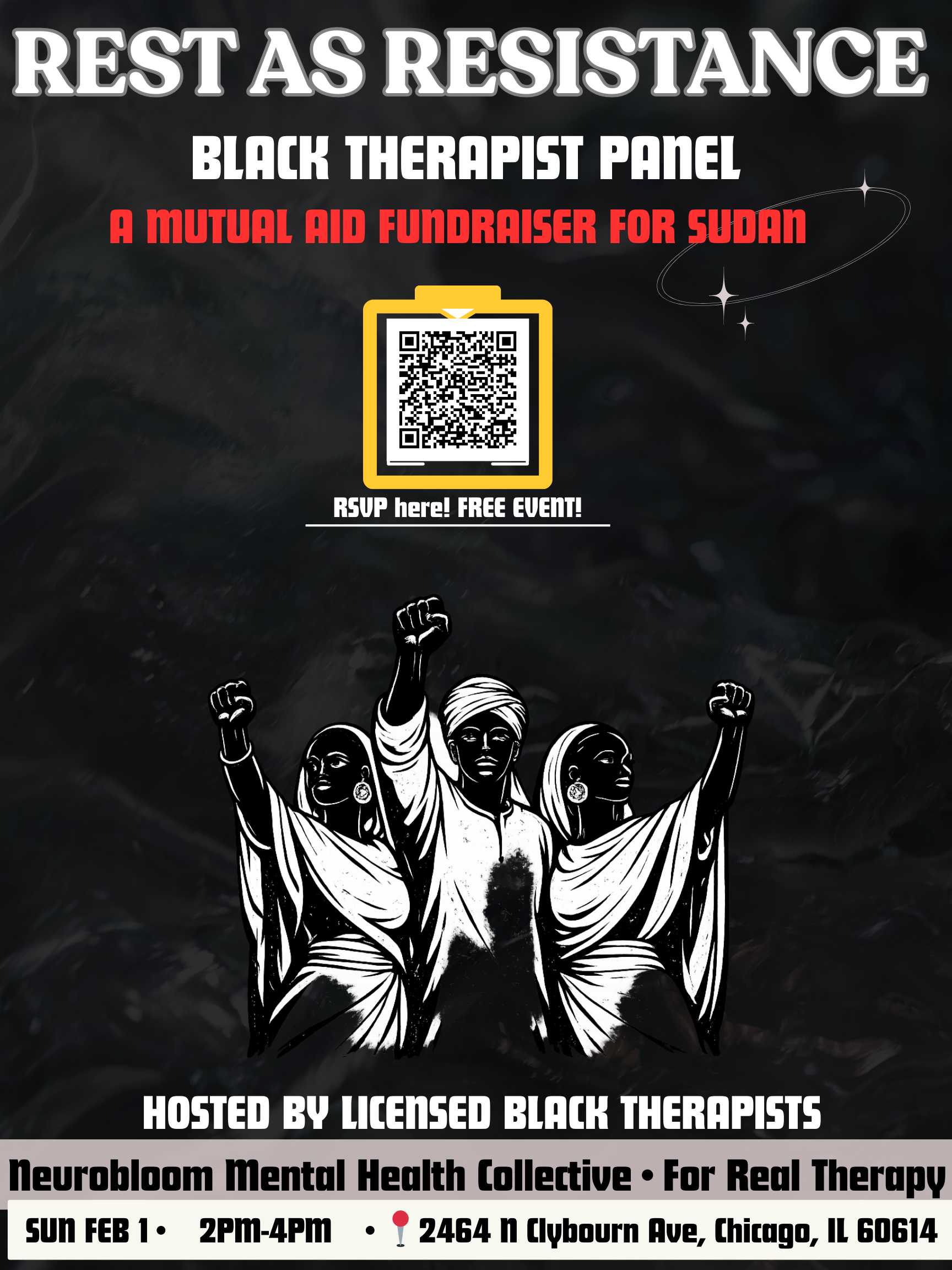 REST as Resistance: Black Therapist PanelFebruary 1, 2026
See the original invitations and read about what took place at NeuroBloom’s past Chicago gatherings.
November 14, 2026 · For Real Therapy · Chicago
The invitation was to explore Sudan through food, music, literature, cinema, wedding traditions, scents, and stories of revolution. Guests were invited to travel through the exhibits with a cultural passport. The event supported Sudan mutual aid and children’s education in Arbaji.
Guests collected passport stamps as they moved through an immersive exhibition of Sudanese history, regional traditions, literature, film, music, food, scent, and solidarity. The evening also included live oud, DJ sets, fashion, and a raffle.
The Chicago event sold out. It raised $10,000 gross, with approximately $9,700 after merchandise reimbursement designated for the school in Arbaji, Gezira State.
The passport led guests through welcome and drinks, literature and poetry, music, the Sudanese table, film and cinema, weddings and jirtiq, scents, jabana and shai, international solidarity, and school life in Arbaji.
The galleries covered Northern, Eastern, and Central Sudan, Kordofan, and Darfur, alongside a South Sudan gallery exploring separation and continuing cultural exchange. The exhibits drew on examples including Nubian doorways and the Nile, Red Sea and Beja histories, Omdurman markets, gum arabic and hibiscus, Darfuri food traditions, and everyday objects such as woven palms and angareeb beds.
The literature room explored preservation, displacement, censorship, and resistance. The wedding room introduced henna, jirtiq, songs, and dancing. The solidarity room brought Sudan into conversation with Palestine, Congo, and Black organizing in the United States, with contributions from PFC, PYM, and BAP.
The program included DJ Akim, DJ Aymen, live oud from Kareem, a fashion show, and a raffle. Guests could also explore Sudanese food, Katkoota Sambousa, and mocktails by St Shai. The evening was organized by Chicago’s Sudanese community, hosted by For Real Therapy, and sponsored by NeuroBloom Mental Health Collective.
June 24, 2026 · Solar Intentions · Chicago
PARIS IS BURNING- PRIDE MOVIE NIGHT
For Pride Month and Juneteenth, we partnered with Solar Intentions for a free screening of Paris Is Burning, one of our favorite films at NeuroBloom. With popcorn, thoughtful nonalcoholic drinks, and a curated discussion led by artist, organizer, and theologian Zebulon B. Hurst, we gathered to explore chosen family, authenticity, grief, and Black and Brown queer liberation.
We love ballroom culture: its creativity, self-expression, community care, and the generations of Black and Brown LGBTQIA+ people who built spaces where people could find recognition and belonging. The film gave us an opportunity to reflect on that legacy and its connections to mental health, identity, survival, and the freedom to live openly.
Zebulon guided a conversation about the film’s deeper themes, including how we create family, navigate exclusion, and make room for one another. The gathering was free, with optional contributions supporting Zebulon’s time, facilitation, and cultural knowledge.
This evening reflected the kind of Black queer-affirming, trans-affirming, and culturally responsive community work we bring beyond the therapy room. At NeuroBloom, our commitment to collective care includes gathering around art we love, learning from community members, and creating opportunities to connect.
Personal Healing. Collective Liberation.
NeuroBloom and Solar Intentions hosted a sober community screening with popcorn, nonalcoholic drinks, and a discussion led by artist, organizer, and theologian Zebulon B. Hurst.
The discussion explored chosen family, ballroom culture, and the ways Black and Brown queer communities create spaces of recognition and belonging.
June 17, 2026 · Chicago
We are living through a crisis of imagination.
People are being systematically stripped of hope, softness, rest, connection, beauty, slowness, and the ability to imagine life beyond survival. We are taught to normalize burnout. To shrink our desires. To adapt ourselves endlessly to systems that exhaust us.
Dare to Dream is a communal interruption.
Rooted in the long tradition of Black radical imagination, liberation movements, healing justice, narrative therapy, music, art, storytelling, and collective care, this immersive Juneteenth experience invites us to practice hope together again.
Because dreaming has always been revolutionary.
Before freedom arrived materially, people rehearsed it. They sang it into existence. They protected it in community. They imagined otherwise while living through conditions designed to collapse the imagination entirely.
This gathering continues that tradition.
Throughout the evening, participants will move through immersive rooms and creative experiences exploring grief, resilience, liberation, music, futurity, and communal imagination through reflective prompts, storytelling, curated sounds, collaborative world-building, art-making, movement, and collective witnessing.
What does freedom sound like?
What would life feel like beyond survival?
What futures become possible when we dare to imagine together?
Inspired by Black radical traditions, abolitionist imagination, resilience frameworks, and healing justice movements, Dare to Dream asks participants to reclaim imagination as a communal practice and a form of resistance.
Come ready to move.
Come ready to create.
Come ready to reflect.
Come ready to witness and be witnessed.
Come ready to practice imagining beyond what this world has told us is possible.
Curated sounds and DJ set.
Free mocktails and refreshments.
Hosted by Black licensed therapists.
Space is limited.
NeuroBloom planned an interactive Juneteenth gathering centered on Black radical imagination, community care, and the practice of imagining collective futures.
Rain affected attendance and the planned format. The original invitation is preserved here as a record of what the event set out to do.
Five Black History Month gatherings with For Real Therapy. The community raised $9,000, and NeuroBloom and For Real Therapy covered the difference so $10,000 was donated.
February 28, 2026
REST as Release closes the REST 2026 series with movement, music, and collective joy.
This DJ-led dance party (DJ’ed by JUS.BE HOUSE COLLECTIVE) centers rest through embodiment and release, honoring music and dance as ancestral tools of regulation, connection, and survival within the Black diaspora. When rest is denied, joy becomes an act of resistance.
The evening invites participants to move, exhale, and celebrate together in a space grounded in care and intention. No performance, no pressure — just presence, rhythm, and collective release.
REST as Release reminds us that joy is not a distraction from struggle, but a vital part of how we endure and imagine what’s possible.
The series closed with a DJ set by JUS.BE House Collective. The evening centered music, movement, and gathering in community.
February 21, 2026
REST as Remembrance centers rest as memory and collective witnessing.
This event brings the community together for a Sudanese film screening followed by a facilitated mental health Q&A led by licensed therapists. Together, we create space to engage Sudanese stories with care, reflect on grief and displacement, and process emotional responses in a grounded, trauma-informed environment.
Through film and conversation, participants are invited to slow down, ask questions, and explore how memory, loss, and resilience live in the body and mind. No prior knowledge of the film or mental health training is required, and participation in discussion is always optional.
REST as Remembrance honors the truth that remembering together is a form of care — and a refusal to forget.
The program paired Sudanese cinema with a facilitated mental health conversation about memory, identity, displacement, and collective care.
February 14, 2026
Held on Valentine’s Day, REST as Reclamation invites participants to reclaim love beyond romance — love as memory, grief, resistance, and cultural continuity.
This Sudanese-centered poetry workshop is facilitated by Israa Abbas, a Sudanese-American poet and archivist and the founder of The Sudanese Poetics Archive and the Sudanese Literature Archive. Israa created these archives in response to the underrepresentation of Sudanese writers and poets, building an accessible, global repository of Sudanese literature across languages and geographies.
The workshop centers poetry and writing as acts of reclamation and rest. Through guided prompts and reflection, participants are invited to engage language as a way to hold love, loss, longing, and collective memory — especially in the context of displacement and erasure.
No writing experience is required. This is not a performance space. Sharing is always optional and consent-based.
The Valentine’s Day workshop centered Sudanese poetry and cultural memory, with space to read, reflect, and write together.
February 7, 2026
REST as Regulation centers rest at the level of the body.
This therapist-led nervous system reset class offers practical, accessible tools for grounding, regulation, and recovery from chronic stress, burnout, and emotional overload. Facilitated by licensed mental health professionals, the session translates nervous system science into practices that can be felt, not just understood.
This class explores:
How chronic stress and trauma live in the nervous system
Simple regulation tools that can be used in daily life
Rest as a skill that can be practiced collectively
Grounding as a form of resistance to constant survival mode
No prior experience with somatic work, meditation, or therapy is required. This is not a fitness class or a performance space. Participants are encouraged to engage at their own pace, with consent and care at the center.
The therapist-led class focused on practical grounding and regulation tools for people navigating chronic stress, burnout, and emotional overload.
February 1, 2026
REST as Resistance opens the REST 2026 series with a Black-led panel of licensed mental health professionals exploring rest as a political, psychological, and communal act.
In a world that demands constant productivity and emotional labor from Black communities, this panel centers rest not as indulgence, but as survival and strategy. Panelists will reflect on burnout, boundaries, nervous system health, and what it means to practice care in systems that were not designed for our rest.
This gathering is intentionally conversational. Attendees are invited to ask the questions they’ve been holding and engage in grounded dialogue with Black therapists who understand the cultural, historical, and structural realities shaping mental health.
This event is free and open to the community and serves as the grounding foundation for the REST 2026 series.
The series opened with a Black-led therapist panel. The program centered a community conversation about rest, burnout, boundaries, and what support can look like in systems that demand constant productivity.
A gathering space for BIPOC therapists, healers, and mental health professionals in Chicago.
Get in touch about future gatherings, the community WhatsApp, or the referral directory. Contact NeuroBloom about Practice in Color.
October 15, 2026 · Chicago
Thursday, October 15, 2026 at 6:00 PM
2464 N. Clybourn Avenue, Chicago, IL 60614
Practice in Color II: Harvesting Community
What we share, we grow.
Join NeuroBloom Mental Health Collective and For Real Therapy for a fall gathering created for BIPOC therapists, healers, and mental health professionals to connect, collaborate, and strengthen our collective networks.
Together, we will create a shared community resource bank featuring trusted referrals, professional services, trainings, community organizations, wellness resources, consultation opportunities, and other tools that can support both our work and the people we serve.
Throughout the evening, we’ll reflect and connect through four community harvest questions:
What are you planting? What are you building, beginning, or hoping to grow?
What are you harvesting? What knowledge, resource, opportunity, or support can you offer?
What are you seeking? What connection, referral, resource, or support do you currently need?
What are you releasing? What professional burden, expectation, or habit are you ready to leave behind?
Come prepared to share what you know, name what you need, and contribute to a resource bank that everyone can use. The evening will include intentional networking, seasonal refreshments, resource sharing, and space to cultivate relationships that continue beyond the gathering.
Come for the connections. Leave with a community behind you.
Through interactive and creative activities, we’ll have space to share what we know, name what we need, meet people doing aligned work, and build something tangible together.
Come with a resource, a need, an idea, or just yourself.
Free to attend. Mocktails and refreshments provided.
NeuroBloom and For Real Therapy brought BIPOC mental health professionals together for resource sharing and conversation. The invitation asked what people were planting, harvesting, seeking, or releasing.
The fall gathering extended the conversations from the August mixer and gave participants a format for naming what they needed and what they could offer.
August 13, 2026 · Chicago
Thursday, August 13, 2026 • 5:30 PM
2464 N. Clybourn Ave., Chicago, IL 60614
We deserve spaces where we do not have to translate ourselves before we can connect. So let’s create one together.
Practice in Color is a gathering for BIPOC therapists, social workers, counselors, psychologists, students, and other mental health professionals to connect, build community, and be fully seen.
We often talk about the unique experience of practicing as clinicians of color, and we know how isolating that can become. Many of us are one of few clinicians of color in our workplaces. We may be expected to serve as therapists, advocates, educators, cultural translators, and representatives, sometimes all within the same room.
We support clients navigating systems that were never designed to protect them while many of us are also navigating, challenging, and trying to transform those same systems ourselves.
Liberation psychology reminds us that healing cannot be separated from culture, history, power, identity, and community. Our lived experiences are part of our clinical wisdom. They shape how we understand safety, family, trauma, belonging, resistance, and what healing can look like.
Practice in Color is an opportunity to find one another. Come network, build relationships, share resources, exchange referrals and ideas, and talk honestly about the realities of the field. Come meet a potential collaborator, mentor, supervisor, referral partner, or friend. Come have a mocktail, a laugh, or a grievance or two with people who understand the layers of this work.
This is a social gathering rather than a formal training or traditional networking event. There is no pressure to prepare an elevator pitch, perform professionalism, or have everything figured out. We are creating a warm, intentional space to connect as clinicians and as people.
Representation matters, and clinicians of color also need community, collaboration, opportunity, rest, and spaces where our cultural knowledge is recognized as knowledge.
We deserve spaces where we do not have to translate ourselves before we can connect.
Let’s create one together.
The first mixer brought BIPOC mental health professionals together for mocktails, informal conversation, and an opportunity to share ideas, resources, and referrals.
The gathering gave participants a way to meet peers and helped lay the groundwork for the ongoing Practice in Color community.
A Chicago gathering for body doubling and parallel play. Bring something you’d like to work on, make, read, or do quietly alongside others.
New dates will be posted here when confirmed.
October 11, 2026 · Chicago
Sunday, October 11, 2026, 2-5PM
PARALLEL ORBIT
Body doubling + parallel play for people who want to get something done.
Bring whatever your brain needs that day.
Maybe it’s the email you’ve been avoiding, the application you keep meaning to finish, homework, budgeting, paperwork, laundry, meal planning, or the calendar you desperately need to update.
Maybe you want to crochet, draw, journal, scrapbook, color, read, do a puzzle, or work on your latest hyperfixation.
Maybe you just need to put your headphones on and exist around other people while you do your own thing.
Parallel Orbit is a neurodivergent-affirming afternoon of body doubling, parallel play, and collective executive functioning. We’ll have focused work periods, breaks, mocktails, and different spaces depending on what kind of energy you need.
🪐 Focus Orbit: admin, laptops, studying, planning, getting sh*t done
🎨 Play Orbit: crafts, hobbies, coloring, puzzles, making things
💬 Social Orbit: lower-focus tasks, chatting, and co-existing
No need to be productive in any particular way. Come do the thing, make the thing, organize the thing, read the thing, or simply borrow a little momentum from being around other brains doing their own thing.
Sunday, October 11 | 2–5 PM
🥤 Mocktails + snacks
🌺 Presented by NeuroBloom Mental Health Collective
Come land. Pick an orbit. Do whatever your brain has been refusing to do alone.
The program made space for people to bring their own work, creative projects, or quiet activities and do them alongside others. The invitation described focused periods, breaks, and space for different energy levels.
NeuroBloom works with community partners to organize cultural events and direct support to community-led needs.
November 2026 · Arbaji, Gezira State
The Chicago event raised $10,000 gross, with approximately $9,700 after merchandise reimbursement designated for the school in Arbaji. The school serves about 310 students.
Community members identified approximately $6,100 in priority needs, including completing an office, painting classrooms, purchasing teaching materials, repairing bathrooms and drainage, and improving shade and seating. These are identified needs. Transfer and project updates will be shared as they are confirmed.
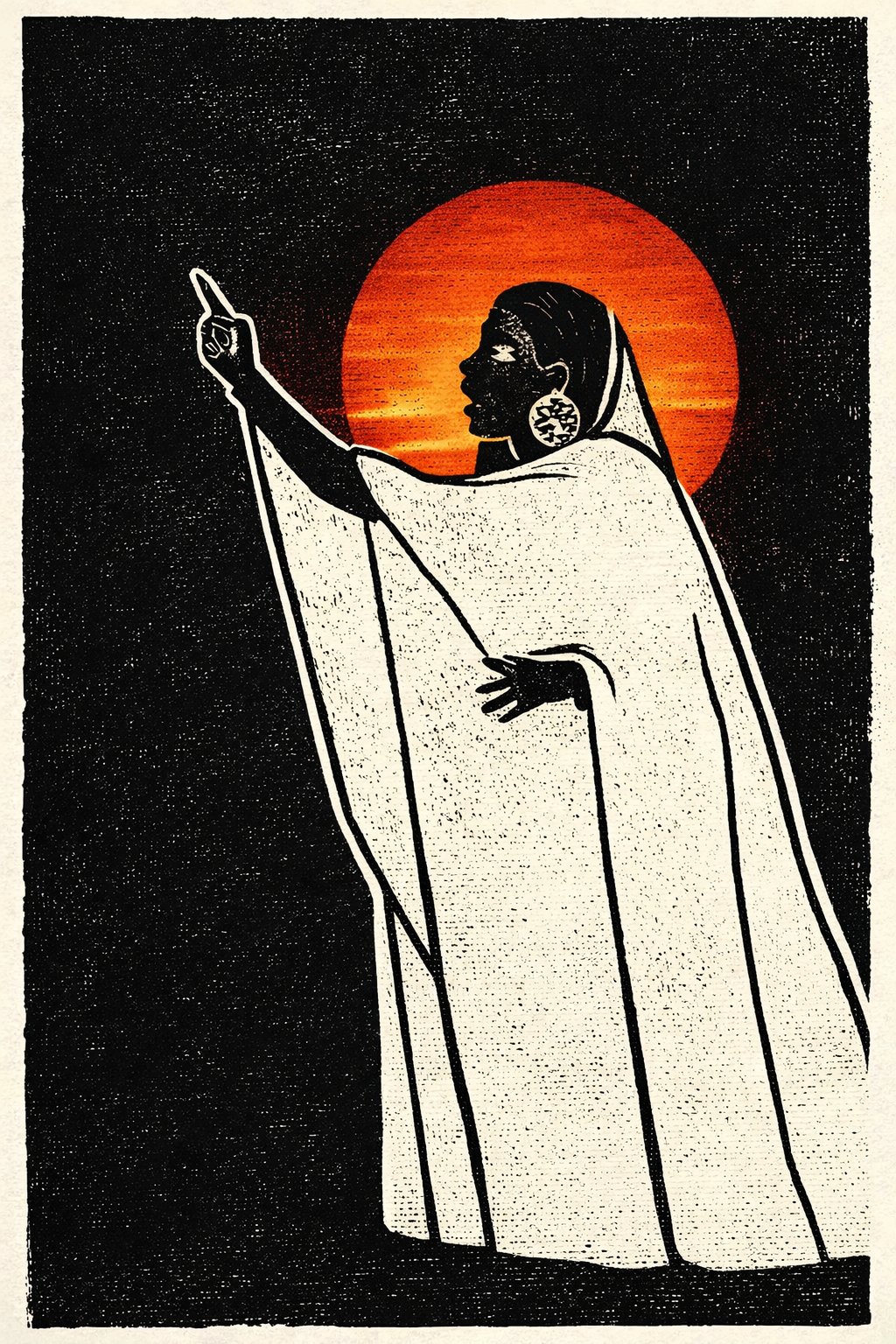
February 2026 · Chicago
The community raised $9,000. NeuroBloom and For Real Therapy covered the difference, bringing the total donated to $10,000 for Sudan mutual aid.
The series brought together a Black therapist panel, nervous system regulation workshop, Sudanese poetry, a film screening and discussion, and a collective dance party.
Trauma-informed, evidence-based, and culturally responsive care that affirms BIPOC, immigrant, LGBTQIA+, and neurodivergent communities.
One-on-one therapy to explore your story, work through what brings you in, and build new patterns at your pace.
Explore Individual Therapy
A space to process, learn, and practice new ways of caring for yourself in community.
Explore Group Therapy
Culturally responsive workshops in nervous system regulation, expressive movement, and collective imagination.
Explore Workshops
Community events that bring together psychoeducation, creativity, and opportunities to connect.
View EventsExplore concerns we work with, the approaches we use, or the communities we serve.
One-on-one therapy that meets you where you are. Our approach is grounded, warm, culturally responsive, and rooted in evidence-based care.
Whether you’re navigating trauma, anxiety, burnout, or identity transitions, we work at your pace. Our sessions can draw on relational, somatic, and liberation-informed approaches, with attention to how your story, nervous system, and culture intersect.
A free consultation gives you a chance to talk through what you’re looking for and ask about therapist fit, availability, and insurance.
Group therapy offers space to understand yourself in relationship with others, explore shared experiences, and practice new ways of communicating and caring for yourself.
We’re developing new therapy groups for 2027. Ask about upcoming groups for confirmed dates, fees, format, and enrollment information.
A space for immigrant and first-generation adults to explore belonging, cultural identity, family expectations, and life between different worlds.
Ask About This GroupTherapeutic conversation, expressive movement, and body awareness to explore emotions, stress, identity, and relationships. No dance experience will be needed.
Ask About This GroupOur approach is culturally responsive, trauma-aware, and neurodivergent-affirming. We emphasize choice and consent, respect boundaries around participation and disclosure, and make room for different ways of communicating and processing.
Before enrollment, a brief consultation helps us understand your goals and determine whether a group fits your needs.
Therapy that makes room for your whole self. NeuroBloom offers culturally responsive, trauma-informed, and neurodivergent-affirming care that centers BIPOC and first-generation experiences.
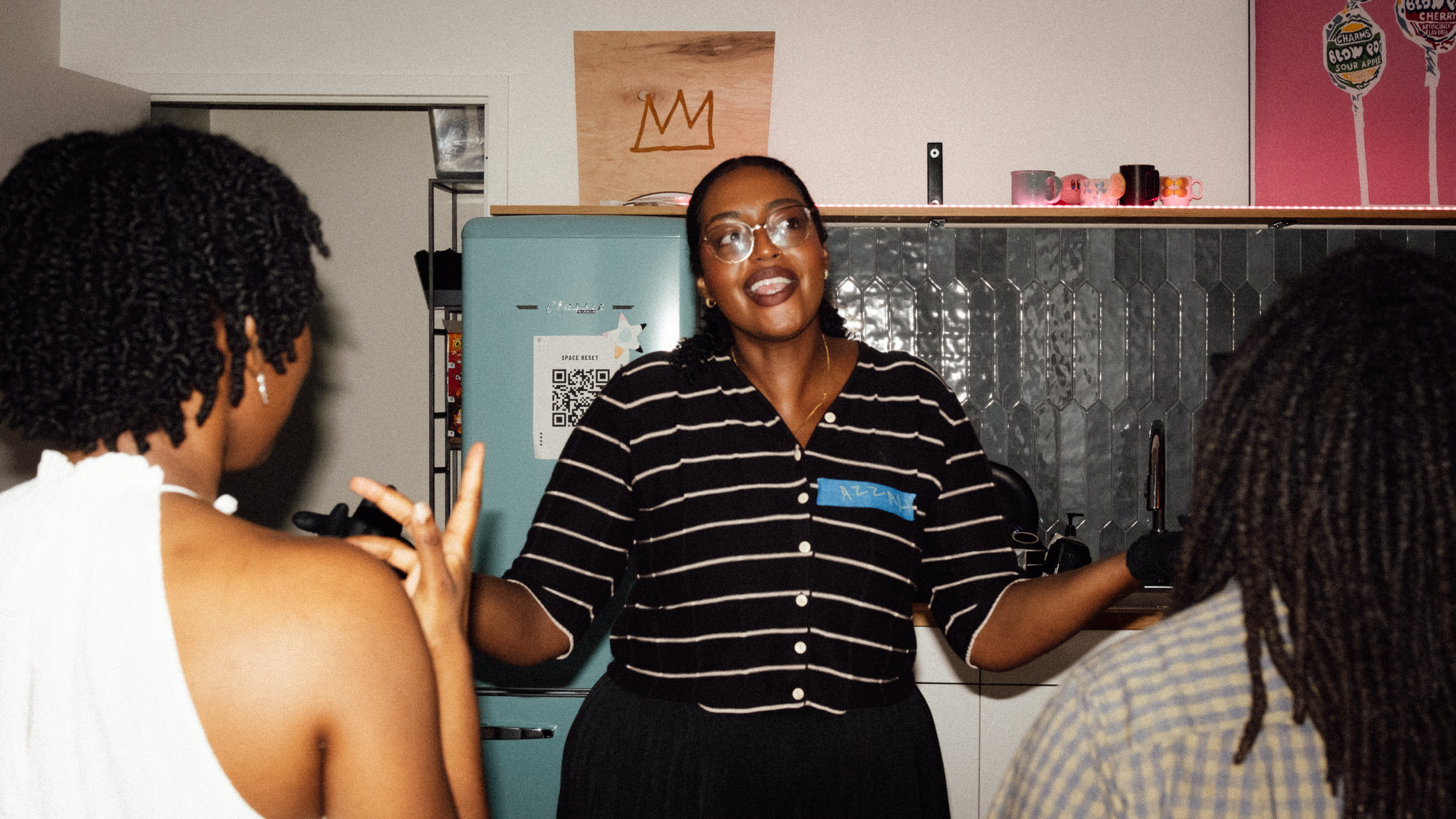
Explore cultural identity, family expectations, migration, belonging, and the experience of living between cultures. Your values and choices guide the work.
Explore Bicultural Identity SupportYou may have a diagnosis, be exploring one, or be recognizing patterns that help your life make more sense. We offer space to develop strategies that fit how you think, communicate, and process.
Explore Neurodivergent-Affirming TherapyAffirming care with room to explore identity, relationships, community, and the other concerns that bring you to therapy.
Explore LGBTQIA+ Affirming CareTherapy may focus on understanding your responses, strengthening boundaries, building coping skills, and reconnecting with your preferences and choices.
Explore Trauma TherapyYou may be managing significant responsibilities while feeling anxious and exhausted. Therapy offers space to examine what that effort is costing you.
Browse Therapy SpecialtiesLoss and transition can reshape your relationships, identity, and expectations for the future. There is room to explore uncertainty and grief that others may overlook.
Explore Grief TherapyWe provide secure telehealth throughout Illinois. Contact us about current in-person availability in Chicago. Appointment options, insurance participation, and areas of expertise vary by clinician.
Explore the concerns and experiences our therapists work with. If several options sound relevant, a consultation can help you decide where to begin.
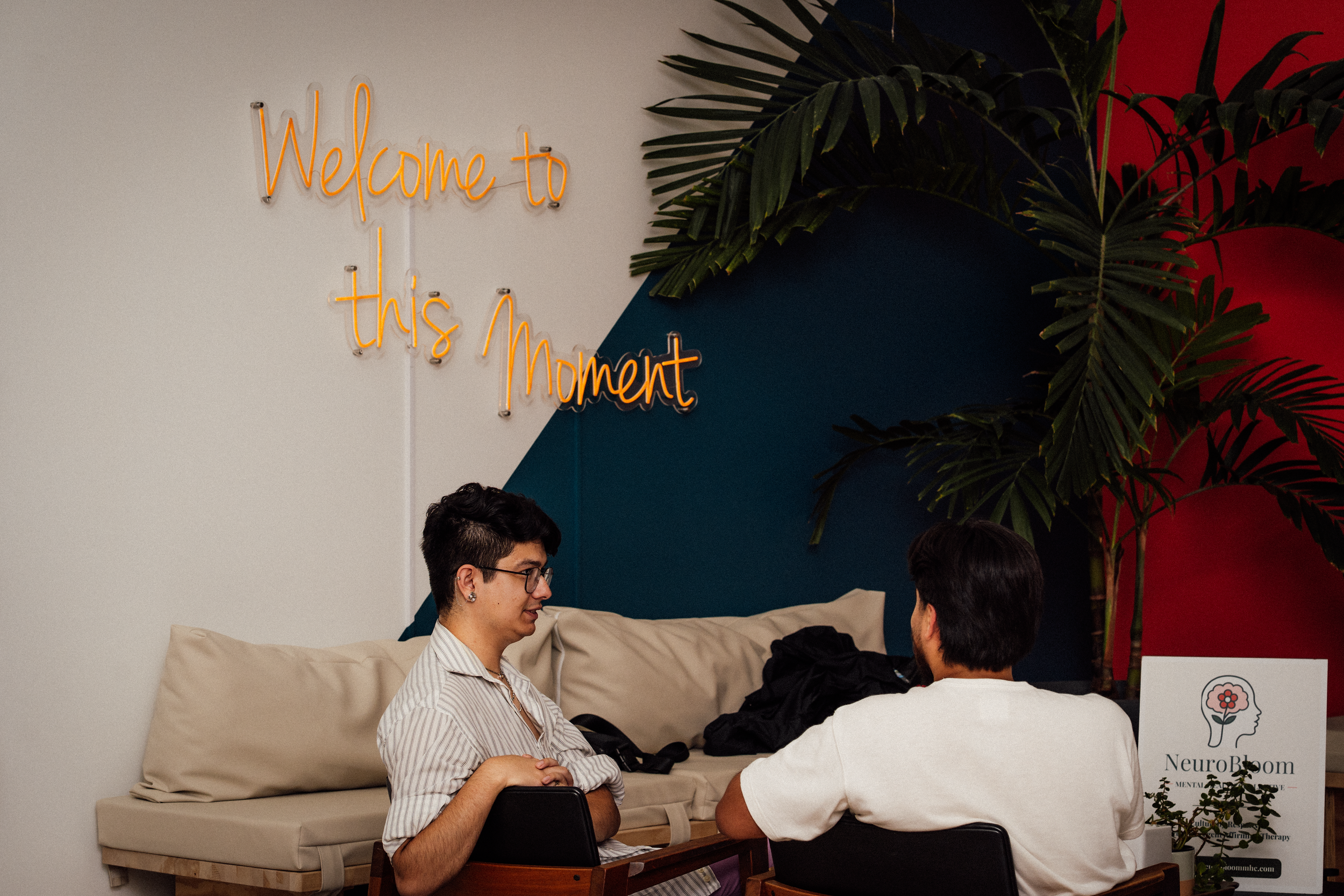
Support for ADHD, overwhelm, task initiation, and ways of organizing daily life that work for you.
Explore Adult ADHD & Executive FunctioningTherapy that honors ADHD, autism, and other neurodivergent experiences as differences, not deficits.
Explore Neurodivergent-Affirming TherapySupport for navigating change, identity shifts, loss of structure, and uncertainty.
Explore Major Life TransitionsTrauma-informed support for survivors of emotional, physical, sexual, or psychological abuse.
Explore Intimate Partner Violence (IPV)Support for healing relationships with food and body without shame or control-based approaches.
Explore Body Image & Eating RecoveryA supportive space to explore sexuality, gender identity, and lived experience without assumptions or judgment.
Explore LGBTQ+ & Gender-Affirming CareCompassionate support for loss of people, relationships, identities, or futures.
Explore Navigating Grief & LossSpecialized support for survivors of manipulation, domination, and psychological control.
Explore Coercive Control RecoveryFocuses on how the brain and nervous system can change with supportive, repeated experiences.
Explore Neuroplasticity & Nervous System RegulationHelp for chronic worry, panic, hypervigilance, and overwhelm.
Explore AnxietySupport for persistent sadness, numbness, low motivation, and disconnection.
Explore DepressionSupport for healing harm caused by rigid belief systems, shame-based teachings, or spiritual abuse.
Explore Religious Trauma & Religious Purity RecoveryCare for long-term or developmental trauma that affects identity, relationships, and the nervous system.
Explore Complex TraumaAffirming support for navigating identity, belonging, family expectations, and cultural transitions.
Explore Immigrant & Third Culture ExperienceYou can bring a concern or a pattern you’ve noticed. Your clinician can help you decide where to start based on what is affecting you day to day.
Explore how NeuroBloom therapists work. Your clinician can discuss which approaches fit your goals, preferences, and the amount of structure that feels helpful.
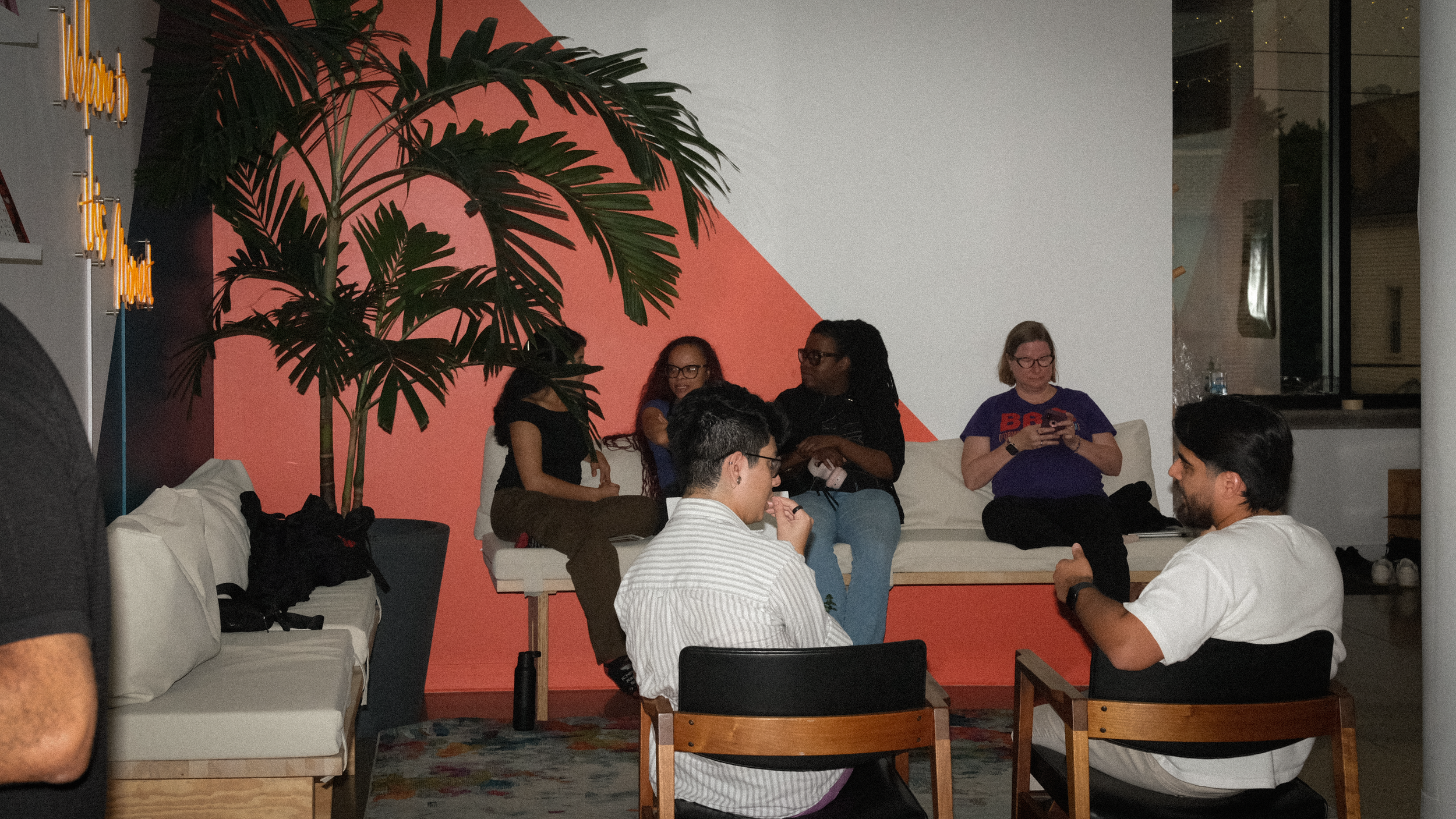
Uses present-moment awareness to build emotional regulation, self-compassion, and clarity.
Explore Mindfulness TherapyTherapy that recognizes how oppression, systems, and social context impact mental health.
Explore Liberation Psychology & Collective HealingTherapy informed by how the nervous system responds to safety and threat.
Explore Polyvagal TheoryA gentle, non-pathologizing approach that helps you understand and care for different “parts” of yourself.
Explore Internal Family Systems (IFS)Therapy that honors ADHD, autism, and other neurodivergent experiences as differences, not deficits.
Explore Neurodivergent-Affirming TherapySupports values-based living while learning to relate differently to difficult thoughts and emotions.
Explore Acceptance and Commitment Therapy (ACT)Helps identify and shift unhelpful thought and behavior patterns.
Explore Cognitive Behavioral Therapy (CBT)Skills-based support for emotional regulation, distress tolerance, boundaries, and relationships.
Explore Dialectical Behavioral Therapy (DBT)Body-based therapy that supports healing through nervous system awareness, sensation, and movement.
Explore Somatic TherapyUses creative expression as a therapeutic tool when words feel insufficient.
Explore Art-Based TherapyYou can ask for a more structured session, more room to talk, or a different approach if something feels hard to use outside therapy.
Interactive mental health and wellness workshops for companies, nonprofits, schools, youth programs, and community groups.
Explore how stress shows up in the body, emotions, attention, and relationships. Activities can include grounding and sensory strategies.
Explore emotions, creativity, and connection through movement. Participants can adapt activities, take breaks, or observe.
Collective imagination workshops rooted in Black radical imagination and collective care, using art-making, storytelling, and reflection.
See the Dare to Dream RecapWorkshops, facilitated conversations, and community events for BIPOC therapists, healers, and care practitioners.
Explore Practice in ColorAn upcoming workshop series on conflict resolution, accountability, and repair.
Ask About the SeriesTo inquire, share your audience, topic of interest, approximate group size, preferred dates, and any accessibility needs.
We offer nervous system regulation workshops, dance and expressive movement workshops, somatic-based embodiment workshops, Dare to Dream collective imagination workshops, and Practice in Color programming. The Revolution Is Relational is coming soon.
Yes. We collaborate with schools, nonprofits, youth programs, and community organizations to provide age-appropriate workshops using creativity, movement, reflection, and mental health education.
Yes. Our workshops can support staff wellness, professional development, team connection, organizational retreats, and community programming.
Yes. We adapt workshop content and activities to your group’s age, goals, setting, and accessibility needs.
No experience is needed. Our expressive movement workshops offer flexible ways to participate, including adapting activities, observing, and taking breaks.
Email info@neurobloommhc.com with information about your group and the workshop you’re interested in.
Neurodivergent-affirming therapy helps you understand your needs and find support that fits how you think, communicate, and process. NeuroBloom is based in Chicago and offers online therapy in Illinois.

You deserve a therapist who understands how you move through the world. We make space for ADHD, autism, AuDHD, and questions about neurodivergence, including late identification.
We adapt sessions to your pace. That might mean a clearer structure, time to process a question, or room to move or take a break. We can explore accommodations, boundaries, and body-based or sensory strategies when they fit your needs.
Complex trauma, adult ADHD, and identity.
Meet AzzahTrauma-informed, neurodivergent-affirming care.
Meet SanaAdult ADHD, trauma, and bicultural identity.
Meet AnahiYou can bring your questions about ADHD, autism, or AuDHD to therapy before you have a diagnosis. A clinician can help you explore what you’re noticing and what supports might fit.
Yes. Therapy can give you space to identify situations that feel overwhelming, notice the demands that lead to burnout, and discuss changes that make everyday life more manageable.
It can include conversation, a clear plan for the session, time to process, or practical work on routines and accommodations. Your preferences help shape how you and your therapist work together.
Yes. You can ask for more direct questions, breaks, a predictable structure, or a different way to participate. You can revisit those preferences as you learn what helps.
Neurodivergent-affirming therapy is a broader approach to care. ADHD therapy can focus specifically on attention, executive functioning, and overwhelm. A formal evaluation is a separate process, so tell us if you need testing or documentation.
Adult ADHD therapy at NeuroBloom helps you understand how your attention and executive functioning show up day to day. Together we explore practical support for starting tasks, managing overwhelm, and finding routines that fit.
ADHD can affect work, school, relationships, and how you feel about yourself. We make room for adults with ADHD as well as people still exploring whether ADHD explains some of their experiences.
We look at specific situations that feel hard and work on changes you can try in daily life. Your therapist can help you think through task structure, sensory needs, communication, and what gets in the way of using strategies consistently.
Adult ADHD, executive functioning, and bicultural identity.
Meet AnahiAdult ADHD, complex trauma, and identity.
Meet AzzahYes. You can bring difficulties with attention, organization, or overwhelm to therapy even if you’re unsure whether ADHD is part of the picture.
It can mean looking at a task that keeps getting stuck and working out what makes it hard to begin, organize, or complete. From there, you and your therapist can try strategies that fit your circumstances.
A formal evaluation and ADHD therapy serve different purposes. Therapy can support daily functioning and emotional well-being. If you need testing or documentation, mention that when you reach out.
Yes. If both are affecting your daily life, you can discuss them with a clinician who works with both concerns. Your goals and comfort help guide where you start.
Trauma therapy offers space to make sense of experiences that still affect your relationships, emotions, or sense of safety. At NeuroBloom, we work at a pace you and your clinician decide together.
You might notice that you feel on guard, shut down, or unsure what you need, even when the experience happened a long time ago. We make room for the culture, identity, and circumstances that shape how you understand what happened.
You and your clinician can spend time getting to know each other, setting goals, and identifying what helps you feel present. If you choose to talk through difficult memories, you can discuss how much detail feels manageable and when to pause.
Complex, religious, and intergenerational trauma.
Meet AzzahTrauma-informed and neurodivergent-affirming care.
Meet SanaYou can start by talking about how things affect you now and what you want from therapy. Your clinician can explain the process and ask what pace feels manageable.
Yes. You can bring the experiences and concerns you want support with. If formal assessment or documentation matters to you, bring that up during the consultation.
You and your clinician make choices about what to talk about, how much to share, and when to pause. Sessions can begin with current concerns, grounding, or building trust.
Yes. You can discuss how family, culture, race, faith, or migration relate to your experience and what you want your therapist to understand about them.
Somatic therapy brings attention to how stress and emotion show up in the body. At NeuroBloom, body-based practices are approached with choice, care, and a pace that works for you.
This approach may be relevant if you notice tension, changes in breathing, shutdown, or difficulty staying present when stress builds. You can ask about how a clinician adapts the work to your body, culture, and sensory needs.
Your therapist may invite you to notice how you’re sitting, how tension changes, or what helps you feel grounded. Practices can be small and optional. You can ask to adapt an exercise or spend the session talking instead.
Somatic, movement-informed, and queer-affirming care.
Meet ShontaeTrauma care with body-based approaches where appropriate.
Meet AzzahAn online session may include noticing sensations, grounding, or gentle movement in the space you have. You and your clinician can adapt the work to privacy, mobility, and comfort.
No. You can ask what an exercise is for, change it, or decline it. Your preferences help guide what you use in a session.
Yes. Tell your clinician what makes it easier or harder to participate. Options can include sitting still, changing the pace, or using a different activity.
Some trauma-informed clinicians use body awareness or grounding as part of therapy. A consultation can help you ask how a particular clinician combines those approaches.
Grief therapy gives you room for the changes, memories, and feelings that come with loss. We work at your pace and make space for the ways grief shows up in daily life.
Grief can follow a death, serious illness, caregiving changes, estrangement, or the loss of a relationship, role, or future you expected.
You can talk about what you miss, what has changed, and what feels hard to carry. If it fits your goals, sessions can also explore caregiving stress, boundaries, or how you want to remember a person or experience.
Grief and loss, caregiver stress, and major life transitions.
Meet JasmineYes. You can bring grief about a relationship ending, estrangement, an illness, or a change in identity or role. Your clinician can help you explore what the loss means to you.
There is no required timeline. You can reach out after a recent loss or about something that still affects you years later.
Yes. Caring for someone can bring practical strain and grief at the same time. You can discuss both and decide what support you want to focus on.
Jasmine Betancourt works with grief, loss, caregiver stress, and life transitions. A consultation is a chance to ask about her approach and availability.
Explore how religious or spiritual experiences have affected your sense of safety, relationships, and choices. At NeuroBloom, you decide how faith, culture, and identity fit into the conversation.
You may be questioning beliefs, making sense of spiritual harm, or navigating family and community relationships after your beliefs or boundaries changed.
You can share what still feels meaningful, what has been painful, and what you want room to question. Your clinician can help you explore the feelings and practical choices that come up without rushing a decision about faith or family.
Religious and intergenerational trauma, culture, and identity.
Meet AzzahReligious trauma and first-generation experiences.
Meet AnahiYes. Therapy can make room for parts of faith that matter to you and experiences you want to examine. Your decisions about belief and participation are yours.
Yes. You can discuss fear, shame, boundaries, or how those experiences affect relationships and your sense of choice today.
You can talk about belonging, grief, boundaries, and how you want to navigate ongoing relationships. Your clinician can work with your goals and circumstances.
Yes. You can talk about how identity, faith, community, and safety intersect. Ask a prospective therapist about their experience with the concerns you want to address.
Anxiety therapy can help you understand patterns of worry, panic, or overwhelm and find practical ways to respond. NeuroBloom’s approach takes trauma, lived experience, and daily demands into account.
You may be keeping up with responsibilities while feeling exhausted, on edge, or stuck in thinking loops. You can bring both what you notice in your body and the situations that make anxiety harder to manage.
You can start with a recent example and talk through what was happening, what you noticed, and what you needed. Your clinician can discuss practical approaches such as grounding or working with thought patterns, depending on your goals.
Compare clinicians’ approaches and ask about support for anxiety.
Meet OurYes. You can begin with how anxiety shows up in your day. A therapist can help you explore patterns over time without expecting you to identify a cause before you start.
You can talk about sensations such as tension, restlessness, or feeling on edge. Ask about ways to work with those experiences, including grounding or body awareness if it feels appropriate.
You can bring concerns about worry, panic, or overwhelm to a consultation. Discuss what you want help with and whether the clinician’s approach fits.
Start with the team profiles or a general consultation. Tell us what you are experiencing and what matters to you, including schedule, coverage, or preferences for how sessions are structured.
